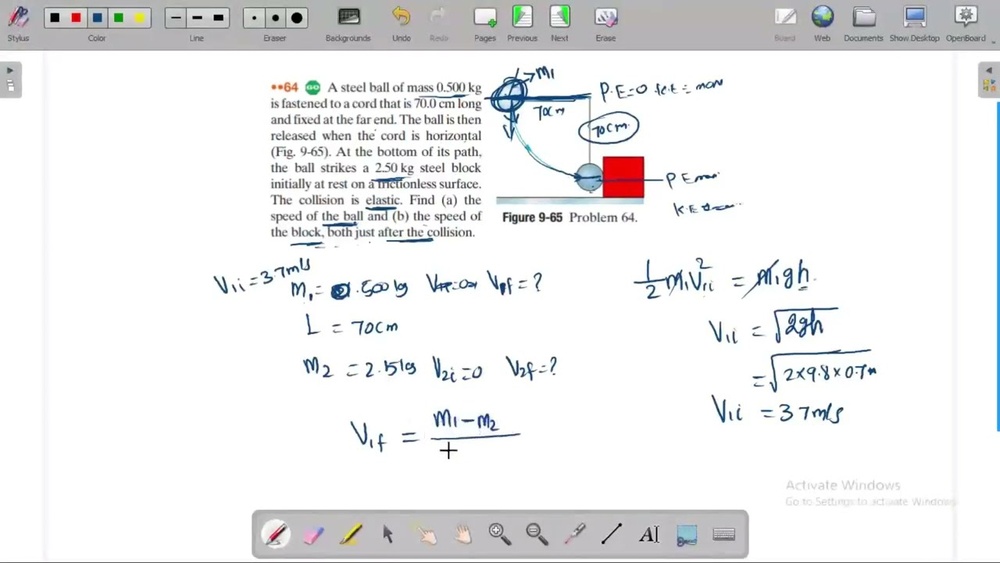
Have you ever wondered what happens when a steel ball weighing exactly 0.500 kg is securely fastened and set into motion? Understanding the forces and motions involved can unlock fascinating insights into physics that apply to everyday life and engineering alike.
Whether you’re a student tackling a tricky problem or simply curious about how objects behave under tension and gravity, this article will guide you step-by-step. By the end, you’ll see how this simple setup reveals powerful principles that govern movement and stability—making complex concepts easy to grasp and apply.
Let’s dive in and discover what makes this steel ball’s story so intriguing for you.
Credit: www.youtube.com
Steel Ball Properties
A steel ball weighing 0. 500 kg is securely fastened to prevent movement. Its mass affects how it responds to forces and motion. This setup helps study the ball’s behavior under different conditions.
The steel ball’s properties define its behavior and use in many applications. Understanding these traits helps in choosing the right ball for tasks. The mass, size, and material type affect its strength and durability.
Each property plays a role in how the ball performs under stress or impact. The ball’s consistent shape and weight make it reliable for precise work. Let’s examine the mass and dimensions first, then explore the material characteristics.
Mass And Dimensions
The steel ball has a mass of 0.500 kg. This weight ensures stability and balance in motion. Its size is uniform, usually measured by diameter. A common diameter for such balls ranges from a few millimeters to several centimeters. These dimensions influence its fit and function in machinery or experiments.
Accurate mass and size help maintain consistent results in tests. The density of steel means the ball is compact yet heavy. This combination makes it useful in applications needing strong, small objects.
Material Characteristics
The steel ball is made from high-grade steel. Steel is an alloy mainly of iron and carbon. This mix gives the ball strength and hardness. Steel resists wear, making the ball durable over time. It also tolerates high pressure without deforming.
Steel’s resistance to rust depends on its type. Some steel balls have coatings to prevent corrosion. The material’s ability to conduct heat and electricity varies with alloy type. Overall, steel balls offer a good balance of toughness and longevity.
Forces Acting On The Ball
Understanding the forces acting on a steel ball fastened in place is important. These forces determine how the ball stays still or moves. Two main forces act on the ball: gravitational force and tension in the fastening. Each force plays a different role in balancing the ball.
Gravitational Force
Gravitational force pulls the ball downwards toward the Earth. It depends on the ball’s mass and gravity’s strength. For a 0.500 kg ball, gravity pulls with a force of about 4.9 Newtons. This force tries to move the ball down, causing tension in the fastening.
Tension In The Fastening
Tension is the force in the string or rod holding the ball. It pulls the ball upward, opposing gravity. This force keeps the ball from falling. The tension must equal the gravitational force for the ball to stay still. If the ball moves, tension changes to balance other forces.
Motion And Equilibrium
Understanding the motion and equilibrium of a steel ball is key in physics. The ball’s movement depends on forces acting on it and how it balances. When a steel ball of mass 0.500 kg is fastened, it can either stay still or move. This depends on the forces and energy involved. Let’s explore the basic concepts of motion and equilibrium in this scenario.
Static Equilibrium Conditions
Static equilibrium means the steel ball does not move. Forces on the ball must balance perfectly. The sum of all forces equals zero. Also, the sum of all torques around any point is zero. If these conditions hold, the ball stays still. Gravity pulls the ball down. The fastening force pulls it up or sideways. These forces cancel each other out in static equilibrium. The ball will not start moving or rotating.
Potential And Kinetic Energy
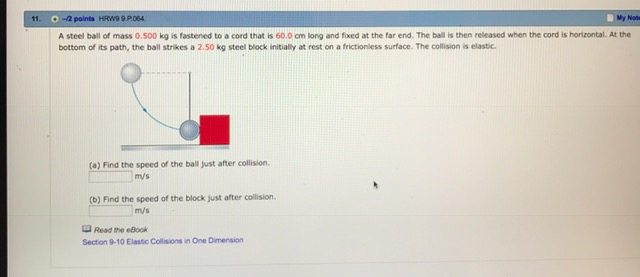
Potential energy is stored energy due to the ball’s position. If the ball is raised, it gains potential energy. The higher the ball, the more potential energy it has. Kinetic energy is energy of motion. If the ball moves, it has kinetic energy. When the ball swings or falls, potential energy changes into kinetic energy. The total energy remains constant if no friction acts. Energy changes explain how the ball moves and stops.
Credit: www.chegg.com
Energy Transformations
Energy transformations describe how energy changes from one form to another in a system. For a steel ball of mass 0.500 kg fastened in place, energy shifts play a key role in its motion and forces. Understanding these changes helps explain the ball’s behavior during movement.
This section covers the main types of energy involved and how energy is conserved or lost in the system.
Conservation Of Mechanical Energy
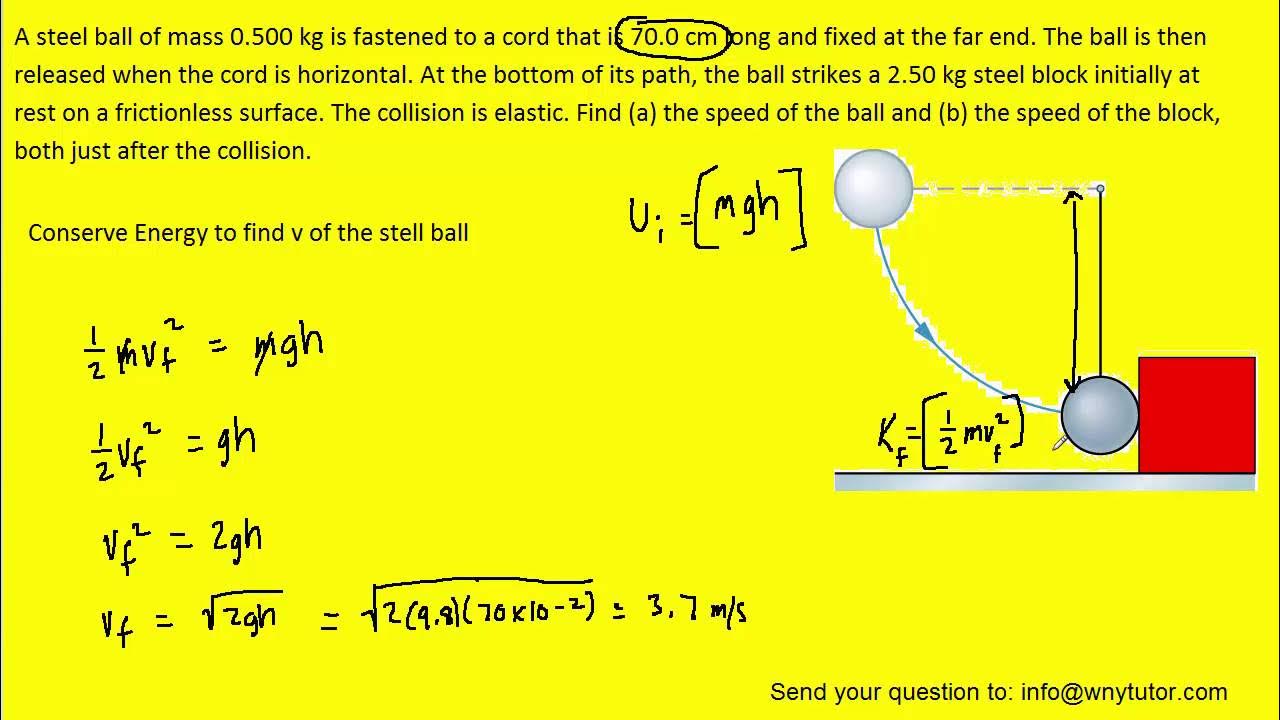
Mechanical energy includes both kinetic and potential energy. For the steel ball, potential energy is highest when it is lifted or stretched. As it moves, potential energy converts into kinetic energy. The total mechanical energy remains constant if no outside forces act on it. This means energy switches between forms but does not disappear.
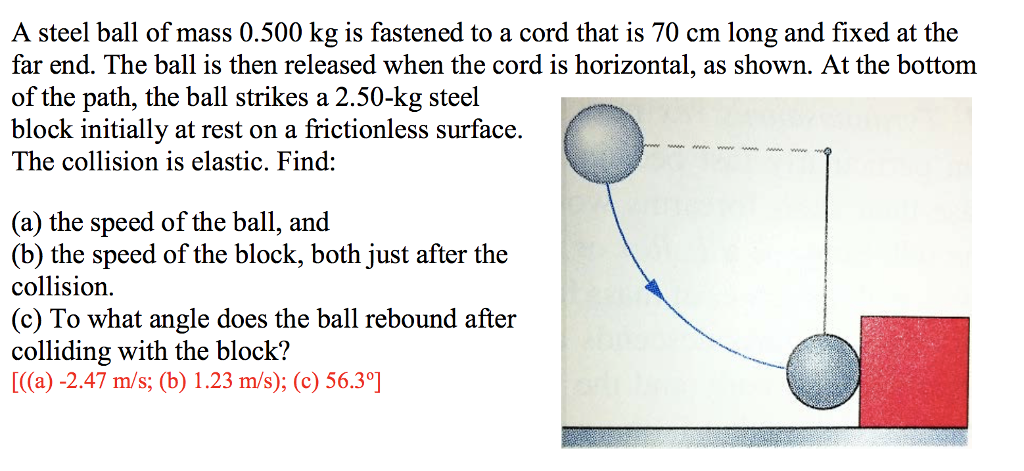
For example, when the ball swings, it speeds up and slows down, showing energy transformation. The energy stored as potential energy at the highest point becomes kinetic energy at the lowest point. This principle is called conservation of mechanical energy.
Energy Loss Factors
In real situations, some energy is lost from the system. Friction and air resistance cause energy to turn into heat. This energy loss reduces the total mechanical energy over time. The steel ball slows down and eventually stops if no extra energy is added.
Energy loss factors are important in practical uses. They explain why the ball does not swing forever. Designers must consider these losses to predict the motion and energy behavior accurately.
Oscillations And Vibrations
Oscillations and vibrations describe the back-and-forth motion of objects around an equilibrium point. They occur in many physical systems, including a steel ball fastened to a string or rod. Understanding these motions helps explain how energy moves and changes form in mechanical systems. The study of oscillations is essential in physics and engineering for designing stable and efficient structures.
Simple Pendulum Model
A steel ball fastened to a string can act like a simple pendulum. The ball swings back and forth due to gravity. The string provides the restoring force that pulls the ball back toward the center. The motion repeats in a regular pattern called periodic motion. This model assumes no air resistance or friction at the pivot point. It helps predict how long one complete swing will take.
Period And Frequency
The period is the time taken for one full swing of the pendulum. It depends on the length of the string and gravity. The mass of the steel ball does not affect the period. Frequency is the number of swings per second. It is the inverse of the period. Frequency shows how fast the pendulum oscillates. These values help describe the motion clearly and predict future positions of the ball.
Credit: www.chegg.com
Practical Applications
The steel ball of mass 0.500 kg fastened in place has many practical uses. It helps us understand physics and engineering concepts. Its behavior under force and motion provides valuable insights for various fields.
The simple setup allows clear observation of forces and movement. This makes it a useful tool in classrooms and labs. The steel ball also plays a role in many engineering designs and experiments.
Engineering Uses
Engineers use fastened steel balls to test stress and impact. They help study how materials react to sudden forces. The ball’s mass and fixed position simulate real-world conditions. This aids in designing safer machines and structures. It also helps check the durability of components under load.
In mechanical systems, these balls can act as weights or counterbalances. They ensure stability and control in moving parts. Fastened steel balls also appear in vibration damping devices. Their predictable weight and position help reduce unwanted motion.
Experimental Demonstrations
In physics labs, the steel ball demonstrates basic principles clearly. Teachers use it to show pendulum motion and energy transfer. Its fixed point allows easy measurement of angles and forces. This makes it perfect for studying simple harmonic motion.
Students learn about gravity, tension, and acceleration using this setup. The ball’s known mass helps calculate forces accurately. It also assists in experiments on collision and momentum. Such demonstrations build a strong foundation in physics concepts.
Frequently Asked Questions
What Is The Mass Of The Steel Ball?
The steel ball has a mass of 0. 500 kilograms. This value is essential for calculating forces and motion in physics problems involving the ball.
How Is The Steel Ball Fastened?
The steel ball is fastened securely, often by a string or rod. This setup allows it to swing or rotate, enabling analysis of pendulum-like motion or circular dynamics.
What Forces Act On The Steel Ball?
The main forces include gravity, tension from the fastening, and possibly air resistance. These forces influence the ball’s movement and equilibrium conditions.
Why Study A Steel Ball Of 0.500 Kg Mass?
Studying this ball helps understand fundamental physics concepts like Newton’s laws, energy conservation, and circular motion in a controlled scenario.
Conclusion
This steel ball example helps explain basic physics concepts clearly. It shows how mass and force work together in motion. Understanding these ideas builds a strong foundation in science. Simple experiments like this make learning more interesting and practical. Keep exploring similar problems to improve your physics skills.