Imagine holding a small rock that weighs just 0.12 kg. Now, picture this rock being fastened securely in place.
What happens next might surprise you. Whether you’re curious about physics, engineering, or just how everyday objects behave, understanding the forces acting on this tiny rock can reveal fascinating insights. Keep reading, and you’ll discover how something so simple can teach you important lessons about motion, balance, and strength.
This knowledge could change the way you see the world around you.

Credit: quizlet.com
Rock Characteristics
The characteristics of a small rock affect its use and behavior. Understanding its properties helps in many fields. This section covers the rock’s mass, size, and material. These factors tell us about its strength and how it interacts with its environment.
Mass And Size
The rock weighs 0.12 kg. This mass is light but enough for many tasks. Its size is small, making it easy to carry. A small size means less surface area. This affects how it fits in spaces or holds against forces.
Material Composition
The rock’s material affects its hardness and durability. It may be made of common minerals like quartz or feldspar. These minerals make the rock strong and tough. The composition also influences how the rock reacts to weather or pressure. Knowing the material helps predict how long it lasts.
Forces On The Rock
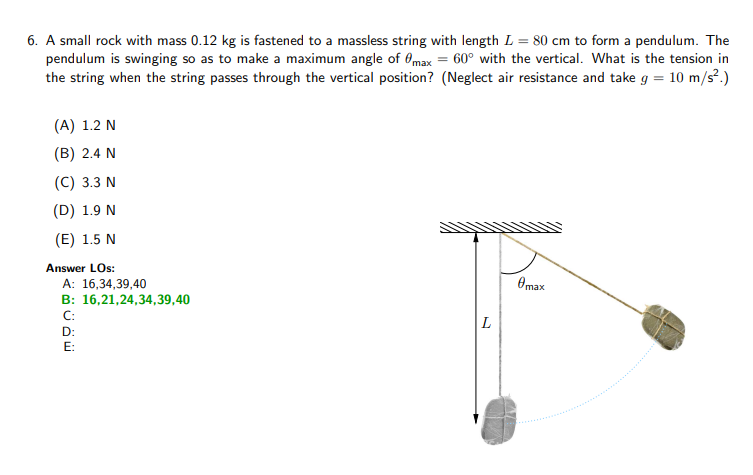
The small rock with a mass of 0.12 kg experiences different forces while it is fastened. These forces affect how the rock stays in place or moves. Understanding these forces helps us see why the rock behaves in certain ways. Let’s explore the main forces acting on the rock.
Gravitational Force
Gravity pulls the rock downward toward the Earth. This force depends on the rock’s mass. For a 0.12 kg rock, gravity pulls with a force of about 1.18 newtons. This force tries to make the rock fall if it is not held tightly.
Tension In The Fastening
The fastening holding the rock creates tension. This force pulls upward or sideways to balance gravity. The tension stops the rock from falling. It adjusts based on how the rock moves or stays still.
Friction And Air Resistance
Friction may act if the rock touches other surfaces. It resists movement between the rock and those surfaces. Air resistance also pushes against the rock if it moves fast. Both forces slow down the rock’s motion.
Motion Analysis
Understanding the motion of a small rock with a mass of 0.12 kg fastened in place requires careful analysis. This section breaks down the key points of motion. We look at forces acting on the rock and how they affect its movement or stillness.
Each part explains important concepts clearly. This helps to see how the rock behaves under different conditions.
Static Equilibrium
Static equilibrium means the rock stays still. The forces on the rock balance each other perfectly. Gravity pulls down with a force equal to the rock’s weight. The fastening force pushes up with the same strength.
Because these forces cancel out, the rock does not move. No acceleration happens. The rock remains at rest as long as the balance lasts.
Possible Movements
Movement can happen if the forces become unbalanced. For example, if the fastening weakens, the rock may slip or fall. External forces like wind or shaking can also cause motion.
The direction and speed of movement depend on the size and angle of these new forces. Small changes can start slow motion or quick shifts. Understanding this helps predict how the rock might behave.
Acceleration Effects
Acceleration occurs when the rock changes speed or direction. This happens if the net force on the rock is not zero. The rock will speed up, slow down, or change its path.
The acceleration size depends on the net force and the rock’s mass. A small rock like this one can accelerate quickly with little force. This is important for safety and design in many cases.
Energy Considerations
Energy plays a key role in understanding the behavior of a small rock with a mass of 0.12 kg. This section breaks down the types of energy involved and how they change as the rock moves or stays still. Grasping these energy types helps explain the rock’s movement and forces acting on it.
Potential Energy
Potential energy is stored energy based on position. For the rock, this energy depends on its height above the ground. The higher it is, the more potential energy it has. This energy comes from gravity pulling the rock down. The formula to find potential energy is mass times gravity times height.
Kinetic Energy
Kinetic energy is the energy of motion. When the rock moves, it gains kinetic energy. The faster it goes, the more kinetic energy it has. The formula for kinetic energy uses half the mass times the speed squared. This energy shows how much work the rock can do while moving.
Energy Conservation
Energy conservation means energy does not disappear. It changes from one form to another. For the rock, potential energy can turn into kinetic energy as it falls. When the rock stops moving, kinetic energy goes back to potential energy or other forms. This principle helps predict the rock’s movement and energy at any time.
Applications And Examples
The small rock with a mass of 0.12 kg, when fastened, finds use in many areas. Understanding its applications helps us see its importance. Simple objects often play key roles in daily tasks and science experiments. This section explores how such a rock fits into real-life and engineering uses.
Real-world Scenarios
Small rocks are used in physics labs to study forces and motion. They help students learn about gravity, tension, and friction. In outdoor activities, rocks can serve as anchors or weights. Gardeners use small rocks to hold down tarps or plants. Even artists use small stones in sculptures and crafts. These examples show how a simple rock has many practical uses.
Engineering Implications
Engineers consider the mass and fastening of small objects in design work. A 0.12 kg rock helps test the strength of ropes and knots. It provides a predictable weight for experiments on balance and tension. Engineers use similar objects to simulate loads on structures. This helps improve safety and reliability. Small masses like this rock are vital in careful planning and testing.
Credit: www.storyofmathematics.com
Credit: www.chegg.com
Frequently Asked Questions
What Is The Significance Of The Rock’s 0.12 Kg Mass?
The rock’s 0. 12 kg mass helps calculate forces like tension and acceleration. It is essential in physics problems involving motion and gravity effects.
How Does Fastening Affect The Rock’s Motion?
Fastening restricts the rock’s movement, allowing it to swing or stay fixed. It influences the forces acting on the rock, such as tension and gravity.
What Forces Act On A Fastened Rock?
A fastened rock experiences gravitational force downward and tension force along the fastening. These forces determine its motion and equilibrium position.
How To Calculate Tension In The Fastening?
Tension equals the force needed to balance gravity and any acceleration. Use Newton’s laws considering the rock’s mass and motion parameters.
Conclusion
This small rock with mass 0. 12 kg shows basic physics principles clearly. It helps us understand forces and motion better. Watching how it moves reveals important lessons in mechanics. Simple experiments like this build strong science knowledge. Everyone can learn from small, everyday objects.
Science becomes easier when we break it down this way. Keep exploring and observing to discover more. Physics is all around us, waiting to be understood.