Imagine holding a small rock that weighs just 0.12 kg. Now, picture it fastened tightly, ready to reveal surprising secrets about motion, force, and energy.
You might think a tiny rock can’t teach you much, but understanding how it behaves when fastened can unlock powerful insights into physics that affect everyday life. If you want to discover how something so small can have such a big impact, keep reading—this simple object has more to tell you than you might expect.
Credit: www.storyofmathematics.com
Rock And Mass Basics
Understanding the basics of rock and mass helps us learn about objects around us. A small rock with a mass of 0.12 kg shows simple science in action. This section explains key facts about the rock and the idea of mass.
Properties Of The Rock
The rock is small and solid. It has a fixed shape and size. The surface feels rough and hard. Its color can vary depending on minerals inside. The rock does not change shape easily. It stays firm when held or fastened. These properties help us identify and study the rock.
Mass And Weight Concepts
Mass is the amount of matter in the rock. It stays the same no matter where the rock is. The mass here is 0.12 kilograms. Weight is different. It depends on gravity pulling the rock down. Weight can change if gravity changes. On Earth, weight is mass times gravity. Knowing mass and weight helps us understand forces on the rock.

Credit: quizlet.com
Forces Acting On The Rock
Understanding the forces acting on a small rock fastened in place helps explain its behavior. The rock, with a mass of 0.12 kg, experiences several forces. These forces affect its motion and stability. Let’s explore the main forces involved.
Gravitational Force
Gravity pulls the rock downward toward the Earth. This force depends on the rock’s mass and gravity’s strength. For a 0.12 kg rock, gravity is about 1.18 newtons. This force keeps the rock attached to the surface. It acts vertically downward, affecting tension and friction.
Tension In The Fastening
The fastening creates tension to hold the rock in place. This tension force pulls upward or sideways, balancing gravity. It prevents the rock from falling or moving. The strength of this tension depends on the fastening method. Proper tension ensures the rock stays secure.
Frictional Considerations
Friction acts between the rock and the surface it touches. This force resists movement or slipping. The rougher the surfaces, the stronger the friction. Friction helps the fastening hold the rock steady. Without enough friction, the rock could slide or fall.
Equilibrium Conditions
Understanding equilibrium conditions is key to studying a small rock fastened in place. Equilibrium means the rock does not move or rotate. Forces acting on the rock balance perfectly. This balance keeps the rock steady despite any pulls or pushes.
Equilibrium helps us predict how objects behave under different forces. It ensures safety in many structures and machines. Let’s explore the basic principles and how to analyze forces on the rock.
Static Equilibrium Principles
Static equilibrium occurs when an object is at rest and stays at rest. The rock fastened in place is an example. For static equilibrium, two main rules apply. First, the sum of all forces on the object must be zero. Second, the sum of all moments or torques around any point must be zero. These rules prevent movement and rotation.
For the rock, gravity pulls it down. The fastening force pulls it up or sideways. These forces cancel out. The rock remains still. Understanding these principles helps in designing safe and stable systems.
Force Balance Analysis
Force balance analysis checks if all forces on the rock cancel out. Start by identifying all forces. The rock’s weight acts downward and equals mass times gravity. The fastening force acts in the opposite direction. There may be tension or friction forces too.
Next, add all vertical forces. Their total must be zero for equilibrium. Then, add horizontal forces. They must also total zero. Finally, check the moments around the fastening point. They must balance to stop rotation. Proper force balance means the rock stays fixed and safe.
Credit: www.chegg.com
Calculations Involving The Rock
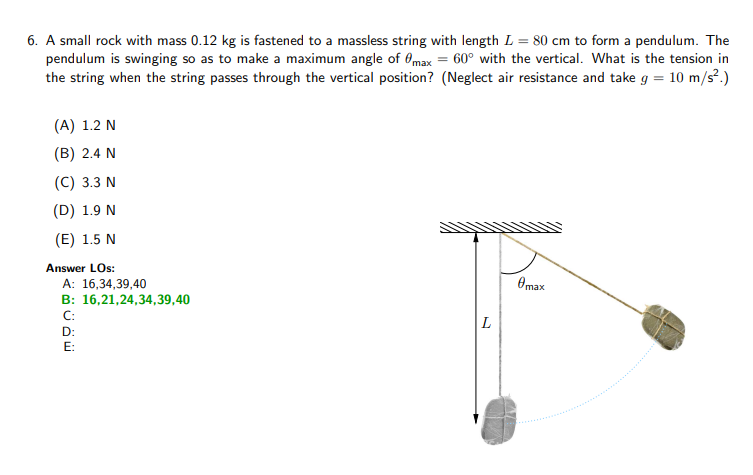
Calculations involving a small rock with a mass of 0.12 kg help us understand the forces acting on it. These calculations are useful in physics to find out how the rock moves or stays still. By studying the forces, we can predict tension and acceleration in different situations.
Let’s explore how to determine the tension force on the rock and look at different acceleration scenarios. Both are important to understand the rock’s behavior when it is fastened.
Determining Tension Force
The tension force is the pull in the string or rope holding the rock. It depends on the rock’s weight and any extra forces. Weight is the force due to gravity and equals mass times gravity (0.12 kg × 9.8 m/s²).
Calculate the weight to find the minimum tension. If the rock hangs still, tension equals its weight, about 1.18 newtons. If the rock moves, tension changes. It can be more or less than the weight depending on motion.
Use the formula T = m × (g + a) for upward acceleration. For downward acceleration, tension is T = m × (g – a). This helps find tension for any movement.
Acceleration Scenarios
Acceleration affects the tension force and the rock’s motion. If the rock speeds up upward, tension increases. If it moves downward or slows down, tension decreases.
For example, if the rock accelerates upward at 2 m/s², tension equals 0.12 × (9.8 + 2) = 1.42 newtons. If it accelerates downward at 2 m/s², tension equals 0.12 × (9.8 – 2) = 0.94 newtons.
Understanding these cases helps predict forces and motion clearly. These simple calculations explain how the rock behaves in many real-life situations.
Energy Perspectives
Understanding energy helps us see how the rock behaves. Energy is the ability to do work or cause change. The rock’s energy changes based on its position and movement. These changes explain many things about the rock’s state.
Energy comes in two main forms for the rock: potential and kinetic. Both play a key role in what happens to the rock. Let’s explore these types to understand the rock better.
Potential Energy Of The Rock
Potential energy depends on the rock’s height above the ground. The higher the rock, the more potential energy it has. This energy is stored and ready to change into motion. The rock’s mass and height both affect this energy. Gravity pulls the rock down, creating this stored power.
Kinetic Energy And Motion
Kinetic energy is the energy of motion. When the rock moves, it has kinetic energy. The faster the rock moves, the more kinetic energy it has. This energy comes from the change of potential energy. Motion shows energy in action, not just stored.
Practical Applications
Understanding how a small rock with mass 0.12 kg is fastened shows useful real-world applications. This simple example helps explain important physics ideas. It also teaches us how to keep objects safe and solve common problems in science and engineering.
Safety In Fastening Objects
Fastening objects properly prevents accidents and damage. Knowing the right force to hold a rock stops it from falling. This principle applies to many things, like hanging pictures or securing tools. Using the correct materials and methods keeps objects steady and safe. It also protects people from injuries caused by falling items.
Common Physics Problems
A small rock fastened to a surface helps explain basic physics. It shows how forces act on objects and how to calculate tension. Students often solve problems about weight, friction, and balance using this example. These problems build a strong foundation in physics. They prepare learners for more complex topics in science and engineering.
Frequently Asked Questions
What Is The Significance Of The Rock’s Mass 0.12 Kg?
The rock’s mass 0. 12 kg determines its weight and affects the forces acting on it. It influences tension and acceleration in physical scenarios.
How Does Fastening Affect The Rock’s Motion?
Fastening restricts the rock’s free movement, allowing controlled motion like circular or oscillatory movement, depending on the setup.
What Forces Act On A Fastened Rock?
The rock experiences tension in the fastening, gravitational force downward, and possibly centripetal force if it moves in a circle.
How To Calculate Tension In The Fastening?
Tension equals the sum of gravitational force and any additional forces from acceleration, calculated using mass, gravity, and motion parameters.
Conclusion
This small rock with a mass of 0. 12 kg shows important physics ideas. It helps us understand forces and motion better. Simple objects like this can teach big lessons. Studying its behavior makes learning science easier. Remember, even small things have interesting stories to tell.
Keep exploring and asking questions about the world around you. Science is everywhere, waiting for you to discover it.