Have you ever wondered what happens when a steel ball is fastened to a cord and set in motion? It might seem simple, but this setup holds fascinating secrets about motion, forces, and energy that you can easily explore.
Whether you’re a student trying to grasp physics concepts or just curious about how things move, understanding this scenario can change the way you see everyday objects. Stick with me, and you’ll uncover surprising insights that make physics feel less like a mystery and more like an exciting puzzle you can solve.
Steel Ball And Cord Setup
This setup involves a steel ball attached to a cord. It is a simple system used in physics experiments. The ball swings around or hangs still depending on forces acting on it.
The cord holds the ball and controls its movement. Understanding the setup helps explain motion and forces clearly.
Physical Description
The steel ball is dense and smooth. It has a fixed mass, which affects how it moves. The cord is thin, strong, and flexible. It connects the ball to a fixed point above.
The length of the cord can vary. The ball hangs at the end, free to swing or stay still. This simple design allows easy observation of forces in action.
Forces Acting On The Ball
The ball experiences several forces at the same time. Gravity pulls the ball downwards. The tension in the cord pulls the ball upwards and sideways.
These forces balance each other when the ball is still. When the ball swings, the forces change in size and direction. This causes the ball to move in a circular path.

Credit: www.chegg.com
Motion Of The Steel Ball
The motion of a steel ball fastened to a cord is interesting to study. The ball moves in a way that depends on forces acting on it. These forces include gravity and the tension in the cord. Understanding the motion helps explain many physical concepts.
The steel ball can swing back and forth or move in a circle. Its path and speed change with time. The cord keeps the ball connected and controls its movement. Let’s explore the types of motion involved and the role of tension in the cord.
Types Of Motion Involved
The steel ball mainly shows two types of motion: circular and pendulum motion. Circular motion happens when the ball swings around a fixed point. The ball moves in a curved path at a constant distance from the center.
Pendulum motion is a type of oscillation. The ball swings back and forth like a pendulum. It moves under the influence of gravity and tension in the cord. The motion repeats in a regular pattern called periodic motion.
Role Of Tension In The Cord
Tension in the cord acts as a force that pulls the steel ball inward. It balances the force of gravity and keeps the ball moving in a circle. Without tension, the ball would fall straight down due to gravity.
The tension changes as the ball swings. It is strongest at the lowest point of the swing. This force controls the speed and direction of the ball’s motion. Tension is crucial for maintaining the ball’s path and stability.
Energy Considerations
Energy plays a key role in understanding the motion of a steel ball tied to a cord. This section explains how energy changes as the ball swings. It helps us predict the ball’s speed and height at different points.
Kinetic And Potential Energy
Kinetic energy is the energy of motion. The faster the ball moves, the more kinetic energy it has. When the ball swings down, it speeds up and gains kinetic energy.
Potential energy is stored energy due to height. The higher the ball is, the more potential energy it holds. At the highest points in its swing, the ball’s speed is lowest, but potential energy is at its peak.
Energy Conservation Principles
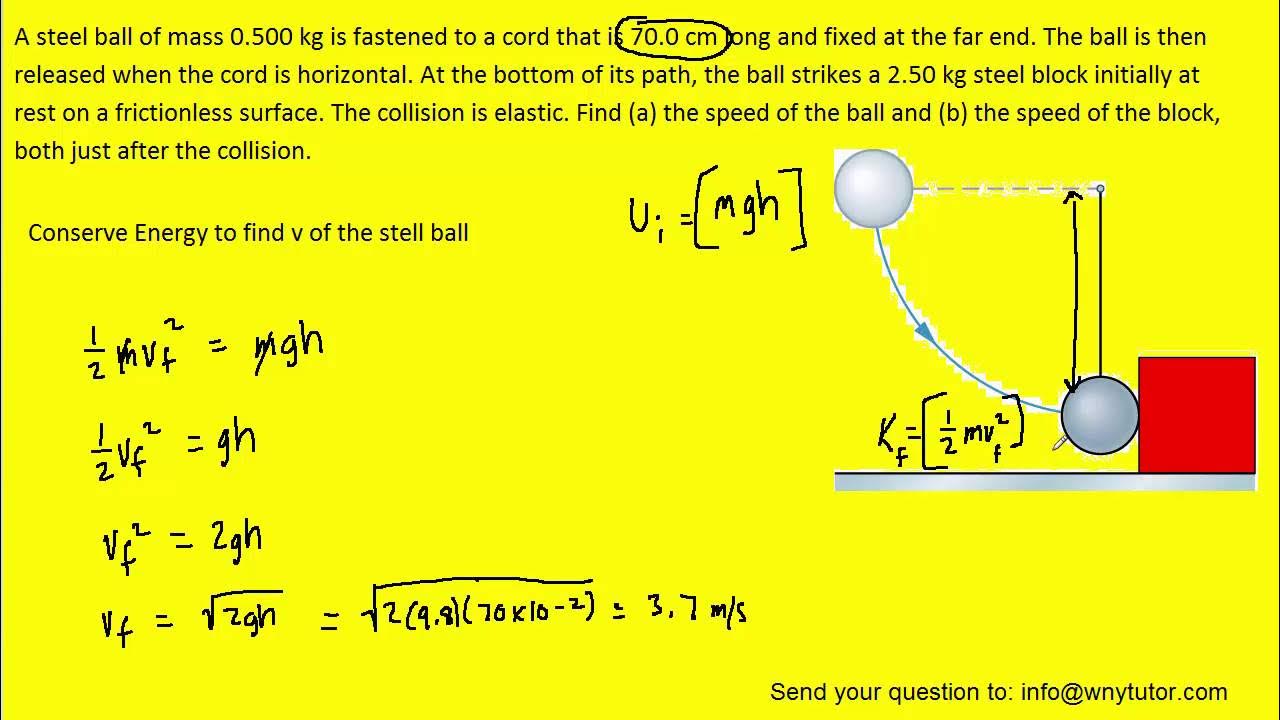
The total energy of the ball and cord system stays constant if we ignore air resistance and friction. This means the sum of kinetic and potential energy does not change.
As the ball moves, energy shifts between kinetic and potential forms. At the lowest point, kinetic energy is highest and potential energy is lowest. At the highest point, potential energy is highest and kinetic energy is lowest.
Credit: www.youtube.com
Calculating Forces And Motion
Calculating forces and motion helps us understand how the steel ball moves. We study the forces acting on the ball and the resulting motion. This knowledge allows us to predict speed, direction, and tension in the cord. The process uses simple physics principles and equations.
By focusing on forces like gravity and tension, we can find how they affect the ball’s path. The ball’s motion follows certain rules, called equations of motion. These equations help us see how fast the ball moves and how the cord stretches or pulls.
Equations Of Motion
Equations of motion describe how an object moves under different forces. For the steel ball, gravity pulls it down. The cord pulls it up or sideways, depending on the ball’s position.
We use formulas like F = ma, where F is force, m is mass, and a is acceleration. This equation shows how forces cause the ball to speed up or slow down. The ball’s path is often circular, so we also use centripetal force equations.
Solving For Tension And Acceleration
Tension is the force the cord applies to hold the ball. It changes as the ball moves. To find tension, we break forces into parts: vertical and horizontal. The vertical part balances gravity. The horizontal part causes the ball to move in a circle.
Acceleration is how fast the ball changes speed or direction. Using the mass and forces, we calculate acceleration from Newton’s second law. Knowing acceleration helps us find the tension in the cord. This keeps the ball moving smoothly without falling or breaking the cord.
Common Physics Problems
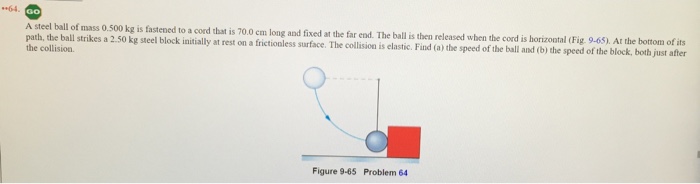
Physics problems about a steel ball tied to a cord are common in learning environments. These problems help students understand forces, motion, and energy. The steel ball swinging or spinning shows real-world physics clearly. These questions improve problem-solving skills and deepen physics knowledge.
Pendulum Motion Examples
A steel ball on a cord acts like a pendulum. It swings back and forth under gravity. Problems often ask for the ball’s speed at the lowest point. Others want the time for one full swing, called the period. Some questions involve the angle the ball reaches during a swing. These examples teach about energy changes and forces in motion.
Circular Motion Challenges
When the steel ball moves in a circle, it shows circular motion. Problems may ask for the tension in the cord. Others focus on the speed needed to keep the ball moving in a circle. Some questions explore what happens if the cord breaks. These challenges explain centripetal force and acceleration in a simple way.
Credit: www.chegg.com
Practical Applications
A steel ball fastened to a cord is more than a simple physics example. It shows how forces and motion work together in real life. This setup helps us understand circular motion and tension in the cord. These ideas have many practical uses in daily life and engineering fields.
Engineering Uses
Engineers use the principles of a steel ball on a cord in many designs. It helps in building safe bridges and tall buildings. The tension in cables and ropes must be strong enough to hold loads. This model teaches how to calculate forces in cables. It also aids in designing cranes and elevators. These machines rely on tension and circular motion to work properly.
Everyday Phenomena
The swinging steel ball also explains common activities. Playground swings work on the same principles of motion and tension. Sports like hammer throw use a similar concept with a ball on a wire. Even the motion of a pendulum clock is related to this setup. Understanding these forces helps us see the physics behind daily movements.
Frequently Asked Questions
What Factors Affect The Motion Of A Steel Ball On A Cord?
The ball’s motion depends on mass, cord length, tension, and gravitational force. Air resistance and friction also influence its path slightly.
How Does The Cord Length Impact The Steel Ball’s Swing?
Longer cords increase the swing period, making motion slower. Shorter cords result in faster swings and smaller arc lengths.
Why Is Tension Important In The Steel Ball’s Cord?
Tension balances gravitational force and centripetal force. It keeps the ball moving in a circular path without falling.
What Role Does The Steel Ball’s Mass Play In Motion?
Mass affects the force required to swing the ball. Heavier balls need more tension but swing with the same period if length is constant.
Conclusion
Understanding how a steel ball fastened to a cord moves helps explain basic physics. It shows how forces like tension and gravity work together. This simple setup reveals important ideas about motion and energy. Anyone studying science can see these principles in real life here.
Keep exploring such examples to learn more about the physical world. Simple experiments often teach the clearest lessons.