Have you ever wondered what happens when a steel ball is fastened to a cord and set into motion? This simple setup holds more secrets than you might think.
Whether you’re curious about physics, engineering, or just love discovering how things work, understanding the forces at play can change the way you see everyday objects. You’ll uncover the surprising science behind a steel ball swinging on a cord, and why it matters to you.
Keep reading, because what you learn here might just spark a new way of thinking about motion and balance in your daily life.
Steel Ball Setup
The steel ball setup is simple yet important for many physics experiments. It helps us study motion, forces, and energy. The setup uses a steel ball tied to a cord. This creates a pendulum-like system. Understanding the parts of this setup is key to getting clear results.
Mass And Cord Details
The steel ball must have a known mass. Usually, it weighs between 50 and 200 grams. The cord is thin but strong enough to hold the ball. It is often made from nylon or cotton. The length of the cord affects how the ball swings. Most setups use cords from 30 to 100 centimeters long. The cord should not stretch or twist during the experiment.
Initial Positioning
Positioning the ball correctly starts the experiment well. The ball hangs freely at rest before any motion. It should not touch any surface or object. To begin, pull the ball aside to a small angle. Usually, this angle is less than 20 degrees. Release the ball gently to start the swing. This initial setup helps measure time and distance accurately.

Credit: www.chegg.com
Forces Acting On The Ball
Understanding the forces acting on a steel ball fastened to a cord helps explain its motion. The ball moves in a circle, so different forces affect it. These forces work together to keep the ball moving smoothly. Each force has a special role in the motion.
Gravitational Force
The ball feels a pull downward. This pull is called gravitational force. It depends on the ball’s mass and Earth’s gravity. This force tries to pull the ball straight down. It affects how the ball swings and hangs from the cord.
Tension In The Cord
The cord pulls the ball inward. This pull is called tension. Tension stops the ball from falling. It also keeps the ball moving in a circle. The amount of tension changes as the ball moves. It balances the forces acting on the ball.
Centripetal Force
The ball moves in a circle because of centripetal force. This force points toward the center of the circle. It is not a new force but comes from tension in the cord. Centripetal force keeps the ball from flying away. It makes the circular motion possible.
Motion Patterns
The motion of a steel ball fastened to a cord shows interesting patterns. These patterns help us understand basic physics ideas. The ball moves in ways controlled by forces and energy. It can swing back and forth or spin in a circle. Both types of motion follow clear rules.
Exploring these motion patterns reveals how the ball behaves over time. The cord’s length and the ball’s mass affect the speed and path. The forces of gravity and tension also play big roles. Watching these motions helps us learn about natural movement.
Pendulum Swing
The ball acts like a pendulum when it swings. It moves back and forth around a fixed point. Gravity pulls it down, and the cord pulls it back. The swing speed changes with the height of the swing. The ball slows at the top and speeds up at the bottom. This motion repeats in a smooth, regular way.
The time for one full swing is called the period. The period depends on the cord length, not the ball’s mass. Longer cords mean slower swings. Short cords make the ball swing faster. This simple motion shows energy moving between potential and kinetic forms.
Circular Motion Dynamics
The ball can also move in a circle if swung around horizontally. This creates circular motion with constant speed. The cord pulls the ball toward the center. This pull is called centripetal force. Without it, the ball would fly away in a straight line.
The faster the ball spins, the stronger the pull on the cord. The tension in the cord grows with speed. The ball’s path stays curved as long as the cord holds. This circular motion is common in many machines and natural systems.
Energy Considerations
Understanding energy is key to studying the motion of a steel ball fastened to a cord. The energy changes show how forces act on the ball. We focus on potential energy, kinetic energy, and their balance during the ball’s swing.
Potential Energy Changes
Potential energy depends on the ball’s height above the ground. As the ball rises, its potential energy grows. When the ball moves lower, potential energy decreases. This energy stores because of gravity pulling the ball down. Height changes cause the potential energy to shift constantly.
Kinetic Energy Variations
Kinetic energy relates to the ball’s speed. When the ball swings faster, kinetic energy rises. At the highest point, the ball moves slowest, so kinetic energy is low. At the lowest point, speed peaks and kinetic energy is highest. Speed changes show clear kinetic energy shifts.
Energy Conservation
The total energy in the system stays the same if no air or friction slows the ball. Potential energy converts into kinetic energy and back again. This process repeats as the ball swings. Energy conservation explains why the ball keeps moving without extra force.
Mathematical Models
Mathematical models help us understand how a steel ball moves when tied to a cord. These models use simple formulas to describe the ball’s motion. They explain forces, speed, and timing. This makes it easier to predict what happens during the movement.
By studying these models, you learn about the physics behind the swinging ball. It shows how different factors like mass, length, and gravity affect the motion. The following sections break down the key parts of these models.
Equations Of Motion
The equations of motion describe how the steel ball moves over time. They are based on Newton’s laws of motion. The main equation uses angular displacement, velocity, and acceleration.
For a ball on a cord, the motion is often circular or pendulum-like. The angle the ball makes with the vertical changes as it swings. The equation includes gravity and the length of the cord.
This helps calculate the position of the ball at any time. It also shows how fast the ball speeds up or slows down during the swing.
Force Calculations
Force calculations show the push and pull on the steel ball. Gravity pulls the ball downwards. The tension in the cord pulls the ball towards the center.
These forces create the swinging motion. The tension changes depending on the ball’s speed and position. At the lowest point, tension is highest because the ball moves fastest.
Calculating these forces helps predict how strong the cord must be. It also helps understand the stresses on the ball during motion.
Period And Frequency
The period is the time it takes for the ball to complete one full swing. Frequency is how many swings happen in one second. These two are connected: frequency is the inverse of the period.
The period depends on the length of the cord and gravity. Heavier balls or different masses do not change the period much. Longer cords mean longer periods and slower swings.
Knowing period and frequency helps in timing and controlling the motion. It is useful in many practical applications involving pendulums and swinging objects.
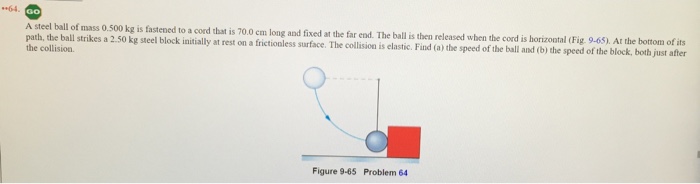
Credit: www.chegg.com
Practical Applications
A steel ball fastened to a cord is not just a simple setup. It has many practical uses in daily life and science. This arrangement helps us understand forces, motion, and energy in a clear way. It also serves many roles in different fields.
Below are some key areas where this simple device plays an important part.
Engineering Uses
Engineers use a steel ball and cord to study pendulum motion. This helps in designing clocks and sensors. The motion shows how energy changes between potential and kinetic forms. It also helps test materials and structures under stress. Engineers analyze swings to predict real-world behavior of parts.
Educational Demonstrations
Teachers use this setup to explain physics concepts. It visually shows gravity, tension, and centripetal force in action. Students easily grasp how forces work in a pendulum. This hands-on example makes learning physics simple and fun. It is a great tool for classrooms and science fairs.
Common Experimental Challenges
Conducting experiments with a steel ball fastened to a cord presents several challenges. These challenges affect the accuracy and reliability of the results. Understanding these issues helps in improving the experimental setup and methods. Below are some common experimental challenges faced.
Measurement Errors
Measuring the length of the cord or the angle of release can be tricky. Small mistakes in measurement lead to big errors in results. Using a ruler or protractor with low precision adds to the problem. Human reaction time also affects timing measurements. Stopping and starting a stopwatch can cause slight delays. These small errors accumulate and change the final outcome.
Friction And Air Resistance Effects
Friction between the cord and the pivot point slows the ball down. This force reduces the ball’s speed over time. Air resistance also acts against the motion of the ball. It causes the ball to lose energy and swing less. Both friction and air resistance are difficult to measure precisely. Ignoring these forces can lead to inaccurate conclusions about the ball’s motion.
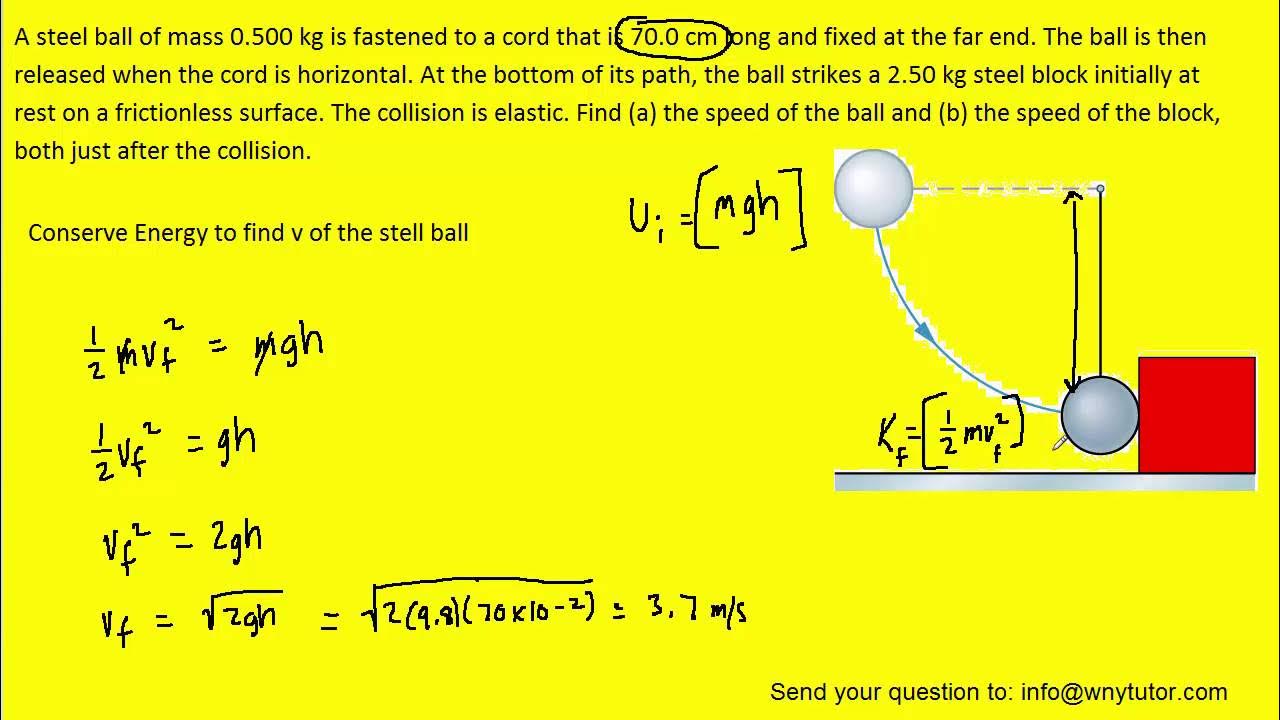
Credit: www.youtube.com
Frequently Asked Questions
What Factors Affect The Motion Of A Steel Ball On A Cord?
The motion depends on the ball’s mass, cord length, and gravitational force. Tension and angular velocity also play key roles in its movement.
How To Calculate Tension In The Cord Holding The Steel Ball?
Tension is calculated using the ball’s mass, gravitational acceleration, and the ball’s velocity. The formula involves centripetal force and weight components.
What Role Does The Cord Length Play In Ball Dynamics?
Cord length determines the radius of the ball’s circular path. It affects the ball’s speed and the tension force in the cord.
How Does Mass Influence The Steel Ball’s Swinging Motion?
Mass impacts the gravitational force acting on the ball. Heavier balls increase tension and affect the speed required for circular motion.
Conclusion
Understanding how a steel ball fastened to a cord moves helps us see physics in action. The forces and motion involved show basic principles clearly. This simple setup explains tension, gravity, and circular motion well. It also connects to many real-life situations, like swings or pendulums.
Studying this helps build a strong foundation in science. Keep exploring these ideas to understand the world better. Science is all around us, in small and big things. Simple experiments often teach the best lessons.