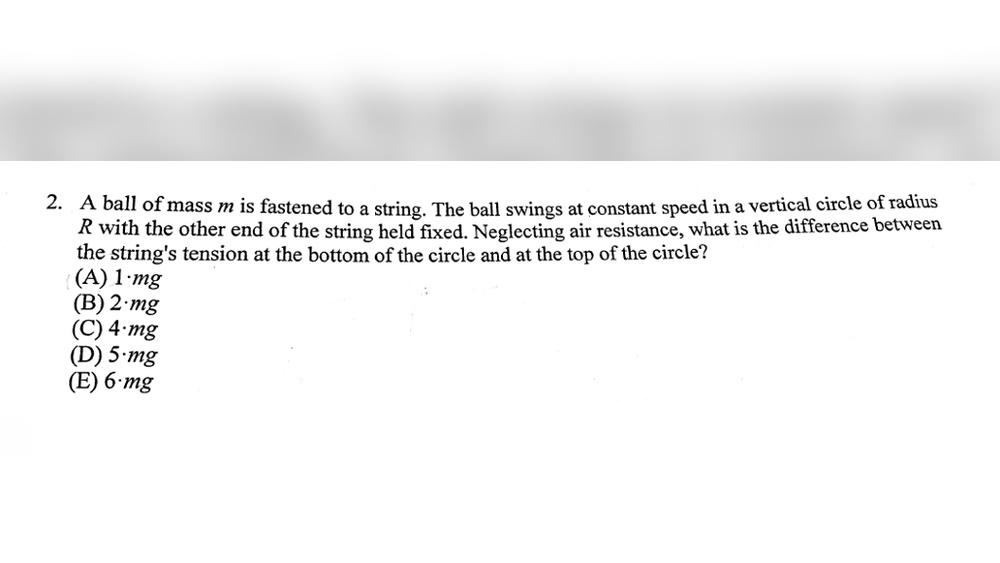
Have you ever wondered what really happens when a ball of mass M is fastened to a string and swung in a vertical circle? It’s more than just a simple motion—you’re stepping into a world where forces, tension, and gravity all play a crucial role.
Understanding this scenario can unlock insights into physics concepts that affect everything from amusement park rides to satellite orbits. You’ll discover how the forces change as the ball moves, why tension varies at different points, and how to calculate these effects with ease.
Ready to unravel the mystery behind this classic physics problem? Keep reading, and you’ll see how simple principles create complex and fascinating motion.
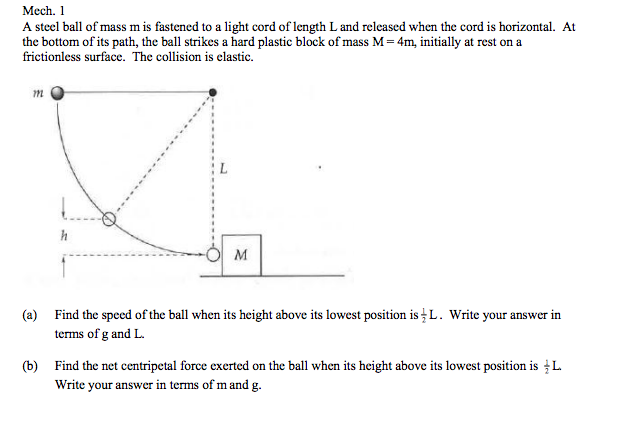
Credit: www.chegg.com
Basic Setup
The basic setup of a ball fastened to a string is simple yet fascinating. It forms the foundation for studying circular motion and forces. Understanding this setup helps explain how objects move in a circle and what forces act on them.
The ball swings around the fixed point where the string is held. Its motion depends on the ball’s mass and the length of the string. The setup shows how tension in the string changes during the motion.
Components Of The System
The system has two main parts: the ball and the string. The ball is a small object with mass M. It acts as the moving part of the system.
The string connects the ball to a fixed point. It keeps the ball moving in a circle. The string is assumed to have no mass and does not stretch.
The fixed point acts as the center of the circular path. It holds the string steady while the ball moves around it.
Role Of Mass And String
The mass of the ball affects the forces acting on it. A heavier ball needs more force to keep moving in a circle.
The string provides this force by pulling the ball towards the center. This force is called tension.
The length of the string determines the size of the circle. A longer string means a larger circular path.
Mass and string work together to control the speed and path of the ball’s motion.
Vertical Circular Motion
Vertical circular motion describes the path of a ball attached to a string moving in a circle standing upright. The ball swings around a fixed point, tracing a vertical circle. This motion involves forces like tension in the string and gravity acting on the ball. Understanding vertical circular motion helps explain many everyday phenomena and physics problems.
Path And Radius
The ball moves along a circular path in a vertical plane. The string acts as the radius of this circle. The length of the string remains constant, setting the circle’s radius. The radius is the distance from the fixed point to the ball. The ball’s path is perfectly round, creating a clear vertical loop.
Speed And Direction
The ball’s speed changes as it moves along the circle. It is fastest at the lowest point and slowest at the top. Gravity influences the speed by pulling the ball downward. The direction of the ball’s velocity changes continuously. It always moves tangent to the circle at any point on the path.
Forces At Play
Understanding the forces acting on a ball fastened to a string helps us grasp the motion better. The ball moves in a circle, held by the string. Several forces work together to keep it moving smoothly. Let’s explore these forces and how they interact.
Tension In The String
The string pulls the ball inward. This pull is called tension. Tension keeps the ball moving in a circle. It changes depending on the ball’s position. The string pulls harder when the ball moves faster or is lower in the circle.
Gravitational Force
Gravity pulls the ball downward. This force is constant and depends on the ball’s mass. Gravity affects the speed and tension in the string. At the top of the circle, gravity and tension both pull down. At the bottom, tension must fight gravity to keep the ball moving.
Net Force And Centripetal Force
The net force points toward the circle’s center. This force is called centripetal force. It keeps the ball turning around the circle. Tension and gravity combine to provide this force. Without centripetal force, the ball would fly off in a straight line.
Tension Variations
The tension in the string changes as the ball moves around the circle. This tension depends on the ball’s position on the path. Understanding these variations helps explain the forces acting on the ball.
The string must provide enough force to keep the ball moving in a circle. This force changes because gravity affects the ball differently at each point. Let’s look at how tension varies at key points on the circle.
At The Top Of The Circle
At the top, the ball is upside down. Gravity pulls the ball downward, toward the center. The string tension is usually lowest here. Sometimes, it can be zero if the ball moves fast enough. The tension must at least balance the ball’s weight.
At The Bottom Of The Circle
At the bottom, the ball is right side up. Gravity pulls the ball down, away from the center. The string must pull harder to keep the ball moving in a circle. This makes the tension highest at the bottom. The string’s force must support the ball’s weight and provide extra centripetal force.
At The Quarter Points
At the quarter points, the ball is halfway between top and bottom. Gravity acts perpendicular to the string here. The tension is between the values at the top and bottom. It changes smoothly as the ball moves through these points. The string balances the inward pull needed for circular motion.
Energy Considerations
Energy plays a key role in understanding how a ball of mass M moves while fastened to a string. The ball swings in a vertical circle, and its energy changes throughout the motion. Examining these energy changes helps us grasp the physics behind the movement. It also shows how forces like tension and gravity affect the ball.
Kinetic Energy Changes
Kinetic energy depends on the ball’s speed. As the ball swings, its speed changes at different points in the circle. When the ball moves faster, its kinetic energy rises. When it slows down, kinetic energy drops. These changes affect how the ball moves along the circular path.
Potential Energy Changes
Potential energy relates to the ball’s height above a reference point. At the top of the swing, the ball has the most potential energy. At the lowest point, potential energy is at its minimum. The ball’s height changes continuously, causing its potential energy to shift during the swing.
Energy Conservation
The total mechanical energy of the ball-string system remains constant if air resistance is ignored. This means the sum of kinetic and potential energy stays the same. Energy transforms between kinetic and potential forms as the ball swings. This conservation helps predict the ball’s speed and position at any point in the circle.
Mathematical Relations
The motion of a ball of mass M fastened to a string involves clear mathematical relations. Understanding these helps explain the forces and speeds involved. The ball moves in a circle, and the string tension changes with its position. The equations below describe these dynamics in simple terms.
Calculating Tension
Tension in the string depends on the ball’s speed and position. At any point, tension equals the force needed to keep the ball moving in a circle plus the weight component. The formula is:
T = m(v² / r) + mg cos θ
Here, m is mass, v is velocity, r is radius, g is gravity, and θ is the angle from the vertical. This tension varies as the ball swings.
Velocity And Angular Speed
Velocity relates to how fast the ball moves along the circle. Angular speed, symbolized by ω, is how fast the ball rotates around the center.
The relation between velocity and angular speed is:
Angular speed stays constant if the ball swings steadily. Velocity changes if the ball moves faster or slower along the path.
Equations Of Motion
The ball’s motion follows the laws of circular motion and gravity. Newton’s second law applies, balancing forces along the radial direction.
The radial equation is:
T – mg cos θ = m(v² / r)
For vertical motion, energy conservation can also be used:
½ mv² + mg r (1 – cos θ) = constant
This shows how kinetic and potential energy exchange as the ball swings.
Common Assumptions
When studying a ball of mass M fastened to a string, several common assumptions simplify the analysis. These assumptions help focus on core physics principles without extra complications. They create an ideal scenario to understand motion and forces clearly.
Ignoring some factors like air resistance or string imperfections makes calculations easier. These simplifications allow students and enthusiasts to grasp how tension and gravity interact in circular motion.
Neglecting Air Resistance
Air resistance is often ignored in this problem. The ball moves through the air, but the effect is small. Ignoring air resistance means no force slows the ball down. This lets the ball maintain a steady speed in its circular path. It simplifies the equations of motion and tension calculations.
Ideal String Properties
The string is assumed to be light and inextensible. It does not stretch or weigh anything. This means the string only transmits tension without adding extra forces. The string’s length stays constant during motion. This assumption keeps the ball’s path circular and predictable.

Credit: www.youtube.com
Practical Applications
The concept of a ball of mass M fastened to a string shows up in many real-life situations. Understanding this simple system helps explain complex motions and forces. It also guides the design of safe and efficient devices. The practical applications range from classic physics experiments to modern engineering challenges.
Pendulum Dynamics
Pendulums use a ball on a string to measure time and motion. The swinging motion depends on the length of the string and the mass of the ball. Clocks use pendulums to keep accurate time. Scientists study pendulum dynamics to understand gravity and energy transfer. This simple system models many natural oscillations and vibrations.
Amusement Park Rides
Amusement rides often mimic the motion of a ball on a string. Swing rides spin riders around like a pendulum moving in a circle. Engineers design these rides to keep riders safe and comfortable. The tension in the cables must be strong enough to hold the riders. The physics of circular motion helps predict forces and speeds during the ride.
Sports And Engineering
Sports like hammer throw use a ball attached to a wire, similar to a ball on a string. Athletes swing the ball to build speed before release. Engineers study this motion to improve equipment and techniques. Understanding tension and speed helps enhance performance and safety. The principles also apply to cranes and robotic arms handling loads.

Credit: www.youtube.com
Frequently Asked Questions
What Forces Act On A Ball Fastened To A String?
The primary forces are tension in the string and gravitational force acting downward. Tension provides the centripetal force needed for circular motion. Gravity affects the ball’s speed and tension at different points in the swing.
How Does The Tension Vary In The String?
Tension is highest at the bottom of the swing due to gravity and centripetal force combined. At the top, tension is lowest as gravity partially supports the ball’s weight. Tension changes continuously during the circular motion.
Why Does The Ball Move In A Vertical Circle?
The ball moves in a vertical circle because the string constrains its path. The tension in the string provides the centripetal force necessary to keep the ball moving along a circular trajectory.
What Factors Affect The Ball’s Speed In The Swing?
Speed depends on the ball’s mass, string length, and gravitational force. Energy conservation principles dictate speed variations, with maximum speed at the lowest point and minimum at the highest point of the circle.
Conclusion
Understanding the motion of a ball fastened to a string helps explain circular movement. The forces on the ball change as it swings around the circle. Tension in the string varies depending on the ball’s position. These principles apply to many real-life situations, like amusement park rides and pendulums.
Grasping this concept improves your knowledge of physics and motion. Keep exploring to see how physics works in everyday life. Simple experiments can make learning these ideas fun and clear.