Have you ever wondered what happens when a steel ball is fastened to a cord and set in motion? It might seem simple, but the forces at play can reveal surprising insights about physics and motion.
Understanding this setup can help you grasp important concepts like tension, gravity, and circular motion in a clear and practical way. Keep reading, and you’ll discover how this basic experiment can unlock a deeper knowledge that applies to everyday life and science alike.

Credit: www.chegg.com
Steel Ball And Cord Setup
The steel ball and cord setup is a common example in physics. It helps us study forces and motion. The setup consists of a steel ball hanging from a cord. Understanding each part’s role is key to grasping the whole system.
This section explains the physical properties of the ball, the cord’s characteristics, and how they connect. Each part affects how the system behaves under different conditions.
Physical Properties Of The Ball
The steel ball is usually dense and heavy. Steel’s density makes the ball compact and strong. The mass of the ball affects the tension in the cord. Its smooth surface reduces air resistance. The ball’s round shape allows it to swing easily. These properties make the ball ideal for physics experiments.
Characteristics Of The Cord
The cord must be strong and flexible. It usually is made from nylon or cotton. Length affects how far the ball can swing. The cord should not stretch much. Stretching changes the motion and forces. Thin cords reduce air resistance but may break easily. The cord’s weight is often small compared to the ball.
Connection Mechanics
The ball fastens to the cord using a secure knot or clamp. The connection must hold under tension. A loose connection can cause inaccurate results. The point of attachment is usually at the ball’s center. This keeps the motion smooth and predictable. Proper fastening ensures safety and accuracy in experiments.
Forces Acting On The Ball
The steel ball fastened to a cord experiences several forces. These forces affect how the ball moves and stays in place. Understanding these forces helps explain the ball’s motion. Each force plays a specific role in the system.
Gravitational Force
Gravity pulls the steel ball downward toward the Earth. This force depends on the ball’s mass and gravity’s strength. It acts vertically downwards. Gravity is constant and always present on the ball.
Tension In The Cord
The cord pulls the ball upward and inward. This pull is called tension. Tension balances the ball’s weight and keeps it from falling. It also helps control the ball’s circular path. The cord’s tension changes with the ball’s position and speed.
Centripetal Force
The ball moves in a circle, needing a force toward the center. This force is centripetal force. It keeps the ball moving around instead of flying away. The tension in the cord provides this inward force. Without centripetal force, the ball would move straight.
Motion Dynamics
Understanding the motion dynamics of a steel ball fastened to a cord helps us see how forces and energy work together. The ball moves in patterns that follow simple laws of physics. These movements show us important ideas about energy, speed, and direction.
Studying this system reveals how motion changes with time and how energy shifts between forms. This knowledge is useful in many areas like engineering, science, and everyday life.
Pendulum Movement
The steel ball swings back and forth like a pendulum. Gravity pulls it down while the cord keeps it moving in a curved path. The motion repeats in a regular cycle. The ball speeds up as it falls and slows down at the highest points. This simple movement shows the balance of forces in action.
Circular Motion Principles
The ball moves along a circular path, held by the cord’s tension. This tension force points toward the center of the circle. It keeps the ball moving in a curve instead of a straight line. The speed of the ball changes, but it stays on the circular track. This motion follows clear rules of circular dynamics.
Energy Transformations
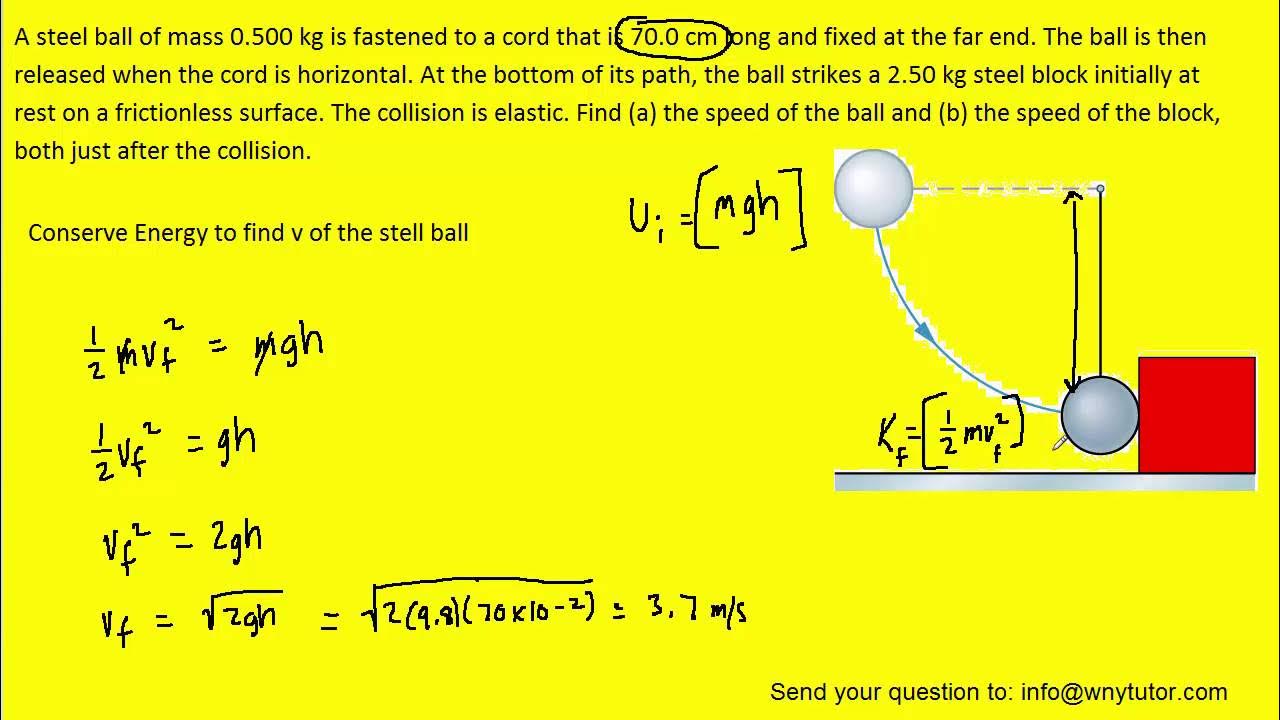
Energy shifts between potential and kinetic forms during the ball’s motion. At the highest points, the ball has more potential energy. At the lowest point, it has more kinetic energy. The total energy stays mostly the same if we ignore friction. These changes explain why the ball moves faster or slower at different points.
Credit: www.youtube.com
Calculations And Formulas
Calculations and formulas help us understand the forces and motion of a steel ball fastened to a cord. These math tools show how the ball moves in a circle and what forces act on it. We use simple physics rules to find tension, speed, and acceleration.
Each calculation gives a clear picture of the ball’s behavior. This knowledge can apply to many real-world problems involving circular motion.
Determining Tension
Tension is the force in the cord holding the steel ball. It keeps the ball moving in a circle. The tension depends on the mass of the ball, the speed of rotation, and the length of the cord. Use the formula:
Here, T is tension, m is mass, v is velocity, and r is the radius of the circle. This formula shows that tension increases with speed and mass.
Calculating Angular Velocity
Angular velocity measures how fast the ball spins around the center. It is usually written as omega (ω). The formula is:
Where v is the linear speed and r is the radius. Angular velocity helps us find how many radians the ball moves each second. This value is key in understanding circular motion.
Using Newton’s Second Law
Newton’s Second Law states that force equals mass times acceleration (F = m a). For the steel ball, the force is the tension in the cord. The acceleration is centripetal acceleration, which points to the center of the circle.
The formula for centripetal acceleration is:
Thus, tension can also be written as:
T = m a = m v² / r
This law links force, mass, and acceleration in circular motion clearly and simply.
Applications And Examples
A steel ball fastened to a cord shows many practical uses. It helps explain key physics ideas. This setup is simple but powerful. It appears in many places, from classrooms to engineering projects. Understanding its applications makes learning physics easier and more fun.
Real-world Scenarios
This setup models real objects moving in circles. Think of a ball on a string or a swinging pendulum. It helps predict forces in rides like swings or amusement park attractions. Understanding tension and motion keeps these rides safe and smooth.
Laboratory Experiments
Teachers use this setup to show motion and forces clearly. It helps students see how gravity and tension work together. Experiments measure speed, force, and time. This hands-on approach makes learning physics active and clear.
Engineering Uses
Engineers study swinging balls to design cables and ropes. They check how much weight ropes can hold safely. This knowledge helps build bridges, towers, and cranes. It also guides the creation of machines that use rotating parts.
Credit: www.chegg.com
Common Misconceptions
Many people misunderstand the physics of a steel ball fastened to a cord. These errors affect how we predict the ball’s motion and forces. Clearing up these misconceptions helps us learn better and apply correct physics.
Some common mistakes involve ignoring forces and making wrong assumptions about the cord and air. Let’s explore three frequent errors and why they matter.
Ignoring Air Resistance
People often forget that air slows down the moving ball. Air resistance acts against the ball’s motion. This force changes the speed and path of the ball. Ignoring air resistance can lead to wrong results in calculations and experiments.
Assuming Massless Cord
Many assume the cord has no weight. Real cords have mass that affects the tension force. The cord’s weight adds to the total force the ball feels. Treating the cord as massless simplifies problems but misses real-life effects.
Misinterpreting Forces
Some confuse the directions and types of forces on the ball. The tension pulls along the cord, and gravity pulls down. Mixing these forces or their directions leads to errors in understanding motion. Correct force analysis is key to solving physics problems.
Frequently Asked Questions
What Is The Effect Of Mass On A Steel Ball’s Motion?
Mass affects the steel ball’s inertia and tension in the cord. Heavier balls require stronger tension to maintain circular motion, influencing speed and stability.
How Does The Cord Length Impact The Steel Ball’s Swing?
Longer cords increase the radius of motion, reducing angular velocity but allowing wider swings. Short cords result in faster, tighter circular paths.
Why Does Tension Vary In A Cord With A Steel Ball?
Tension changes with the ball’s speed and position. It peaks at the lowest point due to combined gravitational and centripetal forces.
What Forces Act On A Steel Ball Fastened To A Cord?
Gravity pulls the ball downward, while tension in the cord provides centripetal force, keeping the ball moving in a circular path.
Conclusion
A steel ball tied to a cord shows simple physics in action. It helps us understand forces and motion clearly. Watching how the ball moves can teach us about energy and tension. These ideas apply to many real-life situations. Experimenting with the ball can make learning fun and easy.
Physics does not have to be hard or boring. Just a small setup can reveal big lessons. Keep exploring, and you will find science everywhere.